
A massive fireball lit up Cape Canaveral on the night of May 28, 2026. Blue Origin’s New Glenn rocket, locked to the pad for a routine hot-fire test, erupted. The blast destroyed the vehicle and tore up critical ground equipment. No one was hurt. The shockwave registered miles away.
You and I both felt the questions that followed. New Glenn is the rocket Blue Origin needs to send its Blue Moon lander toward the Moon. NASA is counting on that hardware for pathfinder missions and later Artemis work. So the practical question hits hard: can Blue Origin still get a lunar launch off this year?
The answer is tight. Company leaders say they will return New Glenn to flight before the end of 2026. The lunar lander itself is still progressing. Whether both pieces line up for a Moon-bound mission in the remaining months is the real test.
What Actually Happened on the Pad
The May 28 anomaly occurred during an integrated static-fire test of the seven BE-4 engines on the booster. Flames climbed the vehicle. Seconds later a full explosion consumed the rocket and damaged Launch Complex 36. The lightning tower and transporter-erector were lost. Fuel tanks, the integration facility, and several other major systems survived in usable condition.
Early investigation pointed to a main oxygen valve on one BE-4 engine. Blue Origin confirmed that finding in August after hardware recovery and component tests. The company is already manufacturing modified valves that can be retrofitted to existing engines. Updated hardware was expected by the end of that month.
Jeff Bezos called it a rough day and promised to rebuild. CEO Dave Limp set the public target: fly again before year’s end. That aggressive timeline rests on the fact that key infrastructure remained intact and on a redesigned pad concept that no longer requires the destroyed transporter-erector.
How the Explosion Hits Lunar Timelines
Blue Origin’s Blue Moon Mark 1 lander, named Endurance, had been pointed at a late-2026 launch on New Glenn. The mission would deliver hardware for NASA’s early Moon Base efforts under a Commercial Lunar Payload Services task order. After the pad explosion that flight slipped. Current internal planning points toward the first quarter of 2027.
Work on the lander never stopped. Environmental testing finished earlier. Multiple Mark 1 vehicles sit in various stages of production. A second lander is being prepared for the VIPER rover. Two more are already in work for Lunar Terrain Vehicle deliveries targeted for 2028. Mark 2 crew-capable landers continue advancing for Artemis 3 demonstration work in Earth orbit and later surface landings.
NASA has signaled flexibility. Administrator Jared Isaacman noted that the agency can tolerate some slip as long as the lander stays on track. The agency is also exploring options that could fly Blue Moon hardware on other vehicles if New Glenn remains grounded longer than expected. That decoupling protects the overall lunar schedule even if Blue Origin’s rocket needs extra months.
The Path Back to Flight
Pad reconstruction began once debris clearance finished. Blue Origin is not simply restoring the old layout. The new design supports horizontal integration and prepares the site for a future, larger New Glenn variant. Parallel work continues on engines, upper stages, and range safety approvals.
Expert observers note that six months from a major pad loss to flight is ambitious. Yet the surviving tank farm, vehicle access tower, and water systems give the company a head start most operators would not have. Limp has repeatedly stressed that the team is treating the recovery as a race they intend to win.
I have watched similar recoveries in this industry. Speed comes from clear root-cause work, spare hardware already in the pipeline, and leadership that refuses to pause other programs. Blue Origin appears to be following that playbook. Lunar lander factories keep running around the clock. That separation of efforts is deliberate.
Realistic Outlook for a 2026 Lunar Attempt
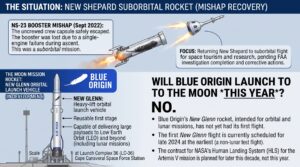
A full lunar mission requires both a flight-ready New Glenn and a flight-ready Blue Moon lander on the same calendar. The rocket side is the pacing item. If Blue Origin achieves a return-to-flight launch by December, a rapid turnaround for a lunar pathfinder becomes theoretically possible but extremely tight. Most external timelines now place the first Blue Moon flight in early 2027.
That delay is real yet not catastrophic for the broader Artemis architecture. NASA’s 2027 Earth-orbit demonstration and 2028 surface landing windows still have margin if the lander hardware itself stays healthy. Blue Origin’s decision to keep producing multiple vehicles in parallel buys insurance against single-point slips.
For you following the story, the next concrete signals will be pad reconstruction milestones, the first modified BE-4 valve installations, and any formal schedule update from NASA or Blue Origin on the Endurance mission.
FAQ
What caused the New Glenn explosion?
A faulty main oxygen valve on one of the seven BE-4 engines during a static-fire test on May 28, 2026.
Did the explosion damage the entire launch complex?
No. The lightning tower and transporter-erector were destroyed, but fuel tanks, the integration facility, vehicle access tower, and water systems remained largely intact.
Is Blue Origin still targeting a 2026 return to flight?
Yes. Company leadership has repeatedly stated the goal of flying New Glenn again before the end of 2026.
Will the Blue Moon lander launch to the Moon in 2026?
Unlikely. The first Mark 1 pathfinder mission has slipped toward early 2027 while New Glenn recovers.
How does this affect NASA’s Artemis plans?
NASA has built in flexibility and is exploring alternate launch options for Blue Moon hardware if needed. The overall 2027–2028 windows remain the focus.
Is work on the lunar landers continuing?
Yes. Multiple Mark 1 and Mark 2 vehicles remain in active production and testing.
What Comes Next
Blue Origin faces a compressed recovery. The company must prove the oxygen-valve fix, rebuild the pad, and clear regulatory hurdles while keeping lunar hardware moving. Success by year’s end would restore momentum. A modest slip into 2027 would still keep Blue Origin relevant for NASA’s near-term Moon goals.
Watch the pad work and the next official schedule notes. The explosion was spectacular. The recovery will decide whether Blue Origin stays on the critical path to the lunar surface.