You settle in for a long highway stretch or a stop-and-go commute and wish the car could handle the boring parts. Modern driver-assistance systems come close, but reliability varies widely. Some feel smooth and trustworthy. Others demand constant corrections.
Drivers who use these systems every day have clear favorites. Real-world feedback, owner forums, and independent tests consistently highlight a handful of modes that deliver the most consistent performance. None of them are fully autonomous. All still require your attention. Yet the best ones meaningfully reduce fatigue and handle routine driving with impressive confidence.
GM Super Cruise: Hands-Free Highway Confidence
Super Cruise stands out for true hands-free operation on mapped divided highways. Available across many Cadillac, Chevrolet, GMC, and Buick models, it combines cameras, radar, and high-definition map data. An infrared driver-monitoring camera tracks your gaze and issues clear alerts if attention drops.
Users repeatedly praise its lane-centering stability and smooth speed control. Owners report thousands of hands-free miles with few unexpected disengagements on supported roads. Consumer Reports has long ranked it near the top for capability and driver-monitoring design. The system only works where GM has mapped the roads, which limits flexibility but increases predictability.
I have used Super Cruise on multi-hour trips. Once engaged, it feels calm and deliberate. The trade-off is coverage—stick to interstates and major highways for the full experience.
Tesla Full Self-Driving (Supervised) and Autopilot
Tesla’s system remains the most ambitious. Autopilot handles basic adaptive cruise and lane centering. Full Self-Driving (Supervised) adds city-street navigation, automatic lane changes, and more complex maneuvers. It relies primarily on cameras and neural networks trained on billions of real-world miles.
Many owners call recent versions the biggest leap yet in smoothness and decision-making. Highway performance is strong, and the ability to navigate surface streets sets it apart. The system requires continuous supervision and will nag if you look away too long. Some drivers find the interventions more frequent than with mapped hands-free systems, while others prefer the broader capability.
Tesla updates the software frequently, so the experience improves over time. Reliability depends heavily on software version, road conditions, and driver vigilance. For users who want the widest operating domain, it leads. For pure hands-free highway relaxation, some prefer Super Cruise.
Ford BlueCruise: Accessible Hands-Free Commuting
BlueCruise brings hands-free driving to a wide range of Ford and Lincoln vehicles, including the Mustang Mach-E, F-150, Expedition, and Explorer. It works on pre-approved “Blue Zones”—primarily divided highways. Driver monitoring uses a camera to confirm attention.
Owners describe it as reliable and less aggressive than some competitors. Recent updates improved lane positioning around trucks and reduced the earlier tendency to “ping-pong” within the lane. Coverage continues to expand. Many commuters find it ideal for daily highway stretches without needing the absolute highest-end hardware.
The system strikes a practical balance: capable enough to reduce fatigue, available on more affordable models than some rivals, and backed by Ford’s service network. Subscription requirements after an initial period are a common point of discussion among owners.
Rivian Autonomy+ Hands-Free System
Rivian’s hands-free offering has gained strong user praise for highway performance and growing coverage. Available on the R1T and R1S, it uses a sensor suite that supports confident lane centering and adaptive cruise on a large and expanding set of roads.
Drivers who have compared it directly with Super Cruise and Tesla systems often note its smoothness and fewer unexpected interventions on supported highways. Rivian continues to push software updates that improve behavior in varied conditions. For owners already in the Rivian ecosystem, the system feels well-integrated and trustworthy for long trips.
Coverage is not yet as extensive as GM’s mapped network in every region, but the trajectory is positive. Users who prioritize a modern EV experience with solid highway assistance frequently rank it high.
Strong Supporting Options: Hyundai/Kia and Mercedes
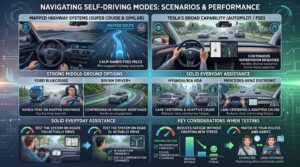
Hyundai and Kia’s Highway Driving Assist (and related systems) earn consistent praise for smooth, predictable behavior at a lower price point. These systems usually require light steering-wheel touch rather than full hands-free operation, yet many owners find them reliable and less intrusive than some higher-end alternatives.
Mercedes Drive Pilot, available in select models and markets, takes a more conservative, highly monitored approach. In regions where it is approved for Level 3 operation under specific conditions, it allows the driver to disengage more fully. Even in Level 2 form, users note refined lane keeping and clear communication of system status.
These systems may not lead every ranking, but they deliver dependable daily performance without the highest subscription costs or coverage limitations of pure hands-free highway systems.
FAQ
Are any of these systems fully self-driving?
No. All current consumer systems are SAE Level 2 (or limited Level 3 in specific cases) and require the driver to remain responsible and attentive.
Which system is best for highway trips?
GM Super Cruise and Rivian Autonomy+ frequently top user lists for hands-free highway reliability. Tesla FSD is highly capable but more supervision-intensive.
Do I need a subscription?
It varies. Some systems include a trial period then require a subscription. Others are included with the vehicle purchase. Check the specific model and region.
How important is driver monitoring?
Very. Systems with strong camera-based attention monitoring tend to encourage safer use and receive higher marks from independent testers.
Can software updates improve reliability?
Yes. Tesla, Rivian, Ford, and GM all push over-the-air updates that refine performance and expand capability over time.
Should I trust the system in bad weather?
Most systems reduce capability or require more driver input in heavy rain, snow, or poor visibility. Always be ready to take over.