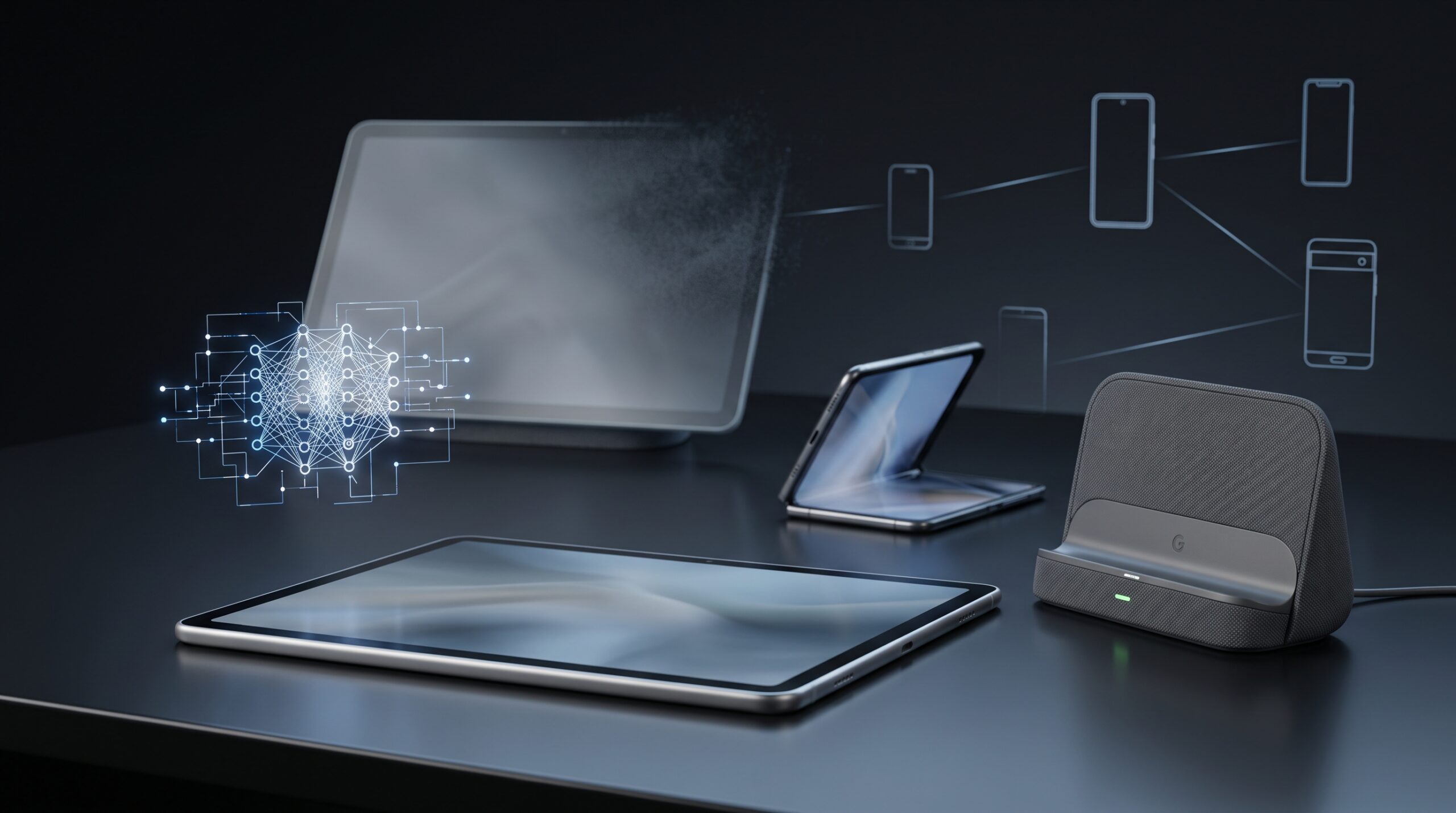
When the company launched the Pixel Tablet in 2023, it wasn’t presented as just another Android tablet. Google positioned it as a device that could move between two roles: a conventional tablet for entertainment and productivity, and a smart-home screen when placed on its charging dock.
That made the product unusual.
But then something happened that Pixel fans weren’t expecting: Google didn’t follow it with a normal yearly successor.
By 2025, reports indicated that Google had canceled development of the Pixel Tablet 2, and Google executives subsequently confirmed that tablet development was on pause.
So why would Google walk away from a category it had only recently re-entered?
The answer appears to involve several factors rather than one dramatic failure. The Pixel Tablet entered a fiercely competitive market, its hardware positioning left room for criticism, and Google’s broader Android strategy was changing rapidly.
There is also a much bigger question.
Does Google really need to build its own Android tablet when its most important mobile strategy is increasingly centered around Pixel phones, foldables, AI and the wider Android ecosystem?
Google Didn’t Simply “Kill” The Pixel Tablet
Before looking at the reasons, there’s an important distinction.
Google hasn’t announced that the original Pixel Tablet has suddenly become unsupported. In January 2026, Google extended the Pixel Tablet’s operating-system support so that it will receive both OS and security updates through June 2028.
That’s actually good news for existing owners.
The tablet launched in June 2023 with a shorter original OS-support commitment, but Google later changed that policy and gave it the same five-year OS-and-security-update period applied to some other Pixel products from that generation.
So when people say “Google stopped making Pixel Tablets,” what they’re really describing is Google’s decision not to continue with a new generation, at least for now.
The distinction matters.
Google can stop developing new hardware while continuing to support the hardware already on the market.
The Original Pixel Tablet Still Has A Purpose
Google’s original concept was actually quite clever.
The Pixel Tablet has an 11-inch display, Tensor G2 processor and a dedicated charging speaker dock. Google designed it to work as a conventional tablet while also becoming a home-oriented device when docked.
That dual-purpose idea was unusual.
Instead of competing purely on screen size and processor performance, Google tried to create a tablet that belonged somewhere between personal computing and the smart-home ecosystem.
The problem wasn’t necessarily that the idea was bad.
The bigger problem was whether enough people wanted it.
The Tablet Market Is Extremely Competitive
Google entered the modern tablet market against companies that already had enormous advantages.
Apple has spent years building the iPad ecosystem. Samsung has multiple Galaxy Tab product lines covering budget, premium and productivity-focused segments. Amazon competes aggressively at the lower end.
Google therefore had to convince consumers to buy a Pixel Tablet rather than an iPad, Galaxy Tab or cheaper Android tablet.
That’s difficult.
A tablet isn’t replaced as frequently as a smartphone. If your existing iPad or Galaxy Tab works well, you may have little reason to purchase another tablet.
That creates a brutal market dynamic.
Smartphones Already Do Most Of The Work
There’s another problem: modern smartphones are extremely capable.
A large-screen phone can handle messaging, social media, streaming video, web browsing, photography and many productivity tasks.
That means the tablet has to offer something genuinely useful beyond “a bigger screen.”
Google’s dock concept was one attempt to solve this.
But the tablet itself still needed to justify its price.
For many consumers, the decision becomes simple: if the tablet is mostly going to sit on a sofa and stream Netflix, why spend premium money on it when a cheaper tablet can perform the same basic task?
That pressure makes differentiation extremely important.
The Pixel Tablet’s Hardware Positioning Was Difficult
When the Pixel Tablet launched, Google gave it a Tensor G2 chip, an 11-inch display and a distinctive charging-speaker dock.
The hardware was capable.
But capability isn’t the same as competitive advantage.
One of the criticisms surrounding the Pixel Tablet was that its display and performance positioning didn’t make it an obvious winner against established premium tablets.
This is especially challenging when your brand is trying to establish a new category.
Apple can sell an iPad because consumers already understand what an iPad is.
Samsung can sell a Galaxy Tab because the Galaxy brand already carries enormous recognition.
Google had to explain why someone should buy a Pixel Tablet specifically.
The Missing Accessories Didn’t Help
Another issue was the productivity story.
A premium tablet becomes more useful when it can replace part of a laptop workflow. That usually requires accessories such as a keyboard, stylus and strong multitasking software.
Reports surrounding the canceled Pixel Tablet 2 indicated that Google had planned improvements including a 120Hz display, Tensor G4, improved cameras and Wi-Fi/5G variants. A keyboard accessory was also among the features enthusiasts had been hoping for.
That tells us something about the original product.
Google appeared to have opportunities to make the second generation substantially more compelling.
But that product never arrived.
The Pixel Tablet 2 Was Reportedly Canceled
This is probably the most important part of the story.
Android Authority reported in November 2024 that Google had canceled the Pixel Tablet 2, citing concerns that the product would not sell well enough.
That would make business sense if Google’s internal forecasts suggested that another tablet wouldn’t generate enough return to justify the development costs.
Hardware development is expensive.
A company has to pay for engineering, manufacturing, supply chains, software optimization, marketing, distribution and long-term support.
If projected sales aren’t high enough, even a technically excellent product can be a poor business decision.
Google Has To Choose Its Battles
This is especially important for Google.
The company doesn’t operate like a small hardware startup with one product.
It has smartphones, foldables, watches, earbuds, smart-home products, AI services and other hardware categories competing for engineering and marketing resources.
Every product consumes resources.
If Google believes a new Pixel tablet will sell fewer units than a new Pixel phone or foldable, management has to ask whether the tablet deserves the investment.
That’s not necessarily a judgment that tablets are worthless.
It’s a resource-allocation decision.
Foldable Phones May Have Changed Google’s Strategy
There’s another compelling explanation: foldables increasingly blur the line between phones and tablets.
Google’s Pixel Fold and later Pixel foldable products provide users with a larger internal display without requiring them to carry both a smartphone and tablet.
That creates an uncomfortable question for a Pixel Tablet.
Why buy two devices when one foldable phone can provide a large-screen experience and remain your primary phone?
Of course, a foldable isn’t a perfect tablet replacement.
A dedicated tablet has a larger display, potentially better battery capacity and a more comfortable form factor for long sessions.
But for some consumers, the convenience of carrying one device is extremely persuasive.
The Foldable Is More Strategically Important
Google’s foldable strategy also gives the company a way to push Android’s large-screen capabilities without necessarily manufacturing a conventional tablet every year.
That’s significant.
The company can continue improving Android for larger displays, multitasking and adaptive layouts while concentrating its own hardware investment on devices that have greater differentiation.
Google’s current Pixel portfolio shows how much emphasis the company is putting on phones and foldables, while its 2026 software updates continue to support the existing Pixel Tablet.
The message is subtle.
Android tablets still matter to Google.
Pixel tablets may not.
Android Tablet Software Has Also Been Evolving
Google’s tablet strategy is bigger than its own hardware.
Android has been improving its large-screen experience, with better multitasking, adaptive interfaces and support for tablets and foldables.
That’s strategically useful because Google doesn’t necessarily need to manufacture every tablet itself to benefit from Android’s growth on larger screens.
Samsung, Lenovo and other manufacturers can build the hardware.
Google can provide the operating system.
That’s a much more scalable strategy.
Google’s Real Goal May Be Android Everywhere
Think about Google’s incentives.
If Samsung sells millions of Android tablets, Google still benefits from Android services, Google Search, Play Store activity and other ecosystem engagement.
Google doesn’t necessarily need a Pixel logo on every tablet.
Its hardware business has a different purpose.
Pixel hardware can demonstrate Google’s preferred Android experience, showcase Gemini and create a tightly integrated ecosystem. But not every category needs a Pixel product if the business case isn’t strong enough.
That distinction helps explain why Google can remain deeply interested in Android tablets while simultaneously pausing Pixel tablet development.
The Original Pixel Tablet Wasn’t A Complete Failure
Calling the Pixel Tablet a failure would be too simplistic.
Google continued supporting it, added new features and eventually extended its software-support period through 2028.
The device also established Google’s ability to build a tablet tightly integrated with Pixel software and the Google Home ecosystem.
Google even continued adding tablet-specific features through Pixel Feature Drops. For example, its March 2024 update introduced productivity improvements for the Pixel Tablet, including changes to Gboard that made better use of the larger display.
That suggests Google wasn’t treating the device as disposable.
The problem was probably commercial momentum.
A product can be technically successful while still failing to generate enough sales to justify a rapid successor.
The Charging Dock Was Clever — But Also Limiting
One of the Pixel Tablet’s defining features was the charging speaker dock.
When docked, the tablet could become a home-oriented screen and provide access to smart-home controls and entertainment. Google designed the device around this idea from the beginning.
That was genuinely different.
But it also created a product-positioning challenge.
Was the Pixel Tablet primarily a tablet?
A smart display?
A Nest Hub replacement?
A family entertainment device?
A productivity machine?
The answer was arguably “a little bit of everything.”
And that can make marketing difficult.
Consumers generally understand products more easily when the value proposition is obvious.
Google May Be Waiting For A Better Tablet Opportunity
The story isn’t necessarily over.
Google’s confirmation that tablet development was paused is different from saying that Google will never make another Pixel Tablet.
Technology markets change.
Android’s tablet software continues evolving. Foldables are becoming more capable. Gemini is becoming increasingly central to Google’s device strategy.
Any of those changes could eventually create a new reason for Google to return.
AI Could Give Google A New Reason To Build A Tablet
This may be the most interesting possibility.
Google is increasingly building its hardware around AI.
Its 2026 Pixel software updates emphasize Gemini, AI-powered creation, personalization and cross-device intelligence.
A future Pixel Tablet could therefore be designed around an AI-first experience rather than simply being “Google’s version of an Android tablet.”
Imagine a tablet that works as a large-screen Gemini assistant, smart-home controller, productivity workstation and entertainment display.
That would be a stronger reason to exist.
But Google would still need to prove that consumers want it.
What Google’s Decision Means For Pixel Tablet Owners
If you already own the Pixel Tablet, there is no immediate reason to panic.
Google’s updated support commitment extends OS and security updates through June 2028.
That’s a meaningful runway.
The bigger issue is future hardware support.
Without a new generation, owners shouldn’t expect a predictable annual hardware cycle like the Pixel phone lineup.
That means buyers should think differently about the device.
If you already own one and it works well, continue using it.
If you’re considering buying one at a heavily discounted price, the remaining software-support period makes the decision more reasonable.
But don’t buy it expecting a Pixel Tablet 2 to arrive next year.
There’s no confirmed product roadmap that supports that assumption.
Should You Buy A Pixel Tablet In 2026?
This depends heavily on the price.
At a significant discount, the Pixel Tablet can still be an interesting Android tablet, particularly for people already invested in Google’s ecosystem.
Its charging dock remains distinctive.
Its Pixel software experience is clean.
And Google’s extended support commitment gives the hardware a longer useful life than originally expected.
But at a high price, alternatives become more attractive.
Samsung offers a broad range of Galaxy Tab products, while Apple’s iPad ecosystem remains extremely mature.
If productivity is your priority, keyboard support, multitasking and accessory availability should be major factors in your decision.
Don’t buy solely because it’s a Pixel.
What Google Should Do If It Returns To Tablets
If Google eventually launches another Pixel Tablet, it needs a much clearer reason to exist.
First, the company needs to make the hardware genuinely competitive.
A high-refresh-rate display, stronger performance, better cameras and excellent battery life would establish a stronger foundation.
Second, accessories need to matter.
A good keyboard and stylus ecosystem could turn the Pixel Tablet from a consumption device into a productivity platform.
Third, Google needs to lean heavily into what makes Pixel different.
AI.
Gemini.
Google Home.
Cross-device intelligence.
Those are areas where Google has genuine advantages.
The Next Pixel Tablet Needs More Than Better Specifications
A faster processor alone isn’t enough.
The successful Pixel Tablet of the future would need to answer a simple question:
Why should someone buy this instead of an iPad, Galaxy Tab or foldable Pixel phone?
If Google can’t answer that clearly, another tablet could face the same commercial problems.
If it can, the category could become interesting again.

Final Takeaway
So, why did Google stop making Pixel Tablets?
The most accurate answer is that Google appears to have paused development of new Pixel tablets rather than permanently declaring the category dead. Reporting indicated that the Pixel Tablet 2 was canceled, and Google executives later confirmed that tablet development was on pause.
The likely reasons are broader than one bad product.
The Pixel Tablet faced intense competition, struggled to establish a compelling reason to choose it over established alternatives, and existed at a time when Google was investing heavily in phones, foldables and AI.
Foldables also give Google another way to deliver large-screen Android experiences without maintaining a conventional tablet lineup.
But the Pixel Tablet itself isn’t abandoned.
Google has extended its OS and security support through June 2028, meaning existing owners still have a useful amount of life ahead.
The bigger question is whether Google can find a better reason to return.
And if it does, the next Pixel Tablet probably won’t succeed by simply being a faster version of the first one.
It will need to be something distinctly Google.
FAQ
Did Google officially cancel the Pixel Tablet?
Google confirmed in 2025 that tablet development was on pause, while reporting indicated that the Pixel Tablet 2 had been canceled. Google has not publicly declared that it will never make another Pixel Tablet.
Why did Google cancel the Pixel Tablet 2?
Reporting indicated that Google was concerned the next Pixel Tablet would not sell well enough. The company therefore appears to have decided that resources could be better allocated elsewhere.
Is Google leaving the Android tablet market?
Not necessarily. Google continues developing Android for tablets and foldables and continues supporting the existing Pixel Tablet. The company’s decision appears more specifically related to its own Pixel tablet hardware.
How long will the original Pixel Tablet receive updates?
Google currently says the Pixel Tablet will receive both Android OS and security updates through June 2028.
Is the Pixel Tablet still worth buying in 2026?
It can be worth considering at a substantial discount, especially if you want Google’s software and smart-home integration. However, buyers should understand that there is no confirmed new-generation Pixel Tablet roadmap.
Will Google make a Pixel Tablet 2?
There is currently no confirmed Pixel Tablet 2 announcement. Development was reported canceled and Google later confirmed that tablet development was paused.
Are Pixel foldables replacing Pixel Tablets?
It’s too strong to say that foldables officially replaced tablets. However, foldables give Google another way to deliver large-screen experiences while keeping the device primarily a phone, which could reduce the strategic need for a conventional Pixel tablet.
What happened to the Pixel Tablet Pen?
A Pixel Tablet stylus appeared through retailers in 2025 even though the expected second-generation tablet had been canceled, although reports indicated that some functionality was not fully implemented.