China’s New Atomic Clock Is More Than Just Ultra-Precise
Yet precision timekeeping has become a serious piece of modern infrastructure. Navigation satellites, telecommunications networks, financial systems, scientific instruments and spacecraft all depend on clocks that can maintain extraordinarily stable frequencies.
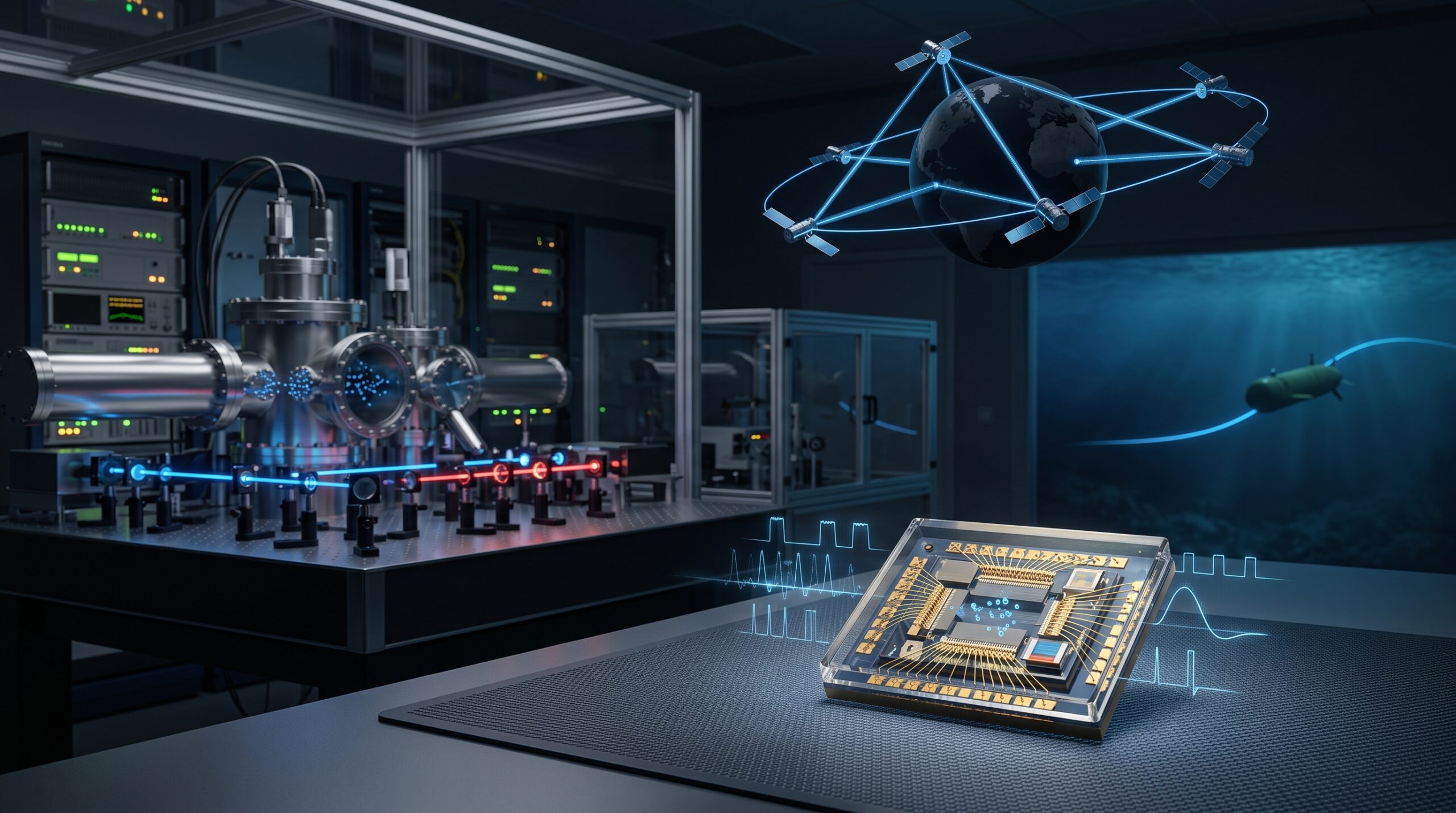
China has made several notable advances in this field during 2026. One particularly practical development is a chip-scale atomic clock that is being mass-produced, with reported accuracy equivalent to an error of roughly one second over 30,000 years. The device is only about 2.3 cubic centimeters, according to China Daily and China’s National Center for Science and Technology Information.
That combination is what makes the development interesting.
Ultra-precise laboratory clocks are not new. The real challenge is making extremely accurate timing technology small, reliable and deployable outside specialized laboratories.
China is also advancing at the high end of precision measurement. In February 2026, the Chinese Academy of Sciences announced that its NTSC-Sr2 strontium optical lattice clock had been used for the first time to calibrate International Atomic Time, or TAI.
And in June, Chinese researchers were among two teams reporting the first working nuclear clocks, a technology that measures transitions involving an atomic nucleus rather than the electrons used by conventional atomic clocks.
So this isn’t simply a story about a clock becoming more accurate.
It’s about who can turn precision time into useful infrastructure.
Why Accurate Time Is A Strategic Technology
Most people rarely think about how much modern technology depends on synchronized clocks.
Your smartphone doesn’t need an atomic clock to tell you whether it’s 2:00 p.m. But the networks connecting billions of devices require highly synchronized timing to coordinate communications, navigation and data.
Financial markets provide another example.
Electronic transactions can happen incredibly quickly, and accurate timestamps help systems establish the sequence of events. Telecommunications networks similarly depend on precise timing to coordinate signals and manage increasingly complicated infrastructure.
Satellite navigation is even more sensitive.
A navigation system determines position partly by measuring how long signals take to travel between satellites and receivers. When those time measurements are incredibly precise, the resulting position calculation becomes dramatically more accurate.
A Tiny Timing Error Can Become A Big Position Error
Radio signals travel extremely quickly.
That means even a tiny timing discrepancy can correspond to a measurable distance.
This is why atomic clocks are so valuable. They provide exceptionally stable frequency references that can be compared and combined with other clocks to create highly accurate time scales.
The underlying principle is elegant.
Atoms have specific energy transitions. Those transitions occur at extremely predictable frequencies, giving scientists a natural reference that is vastly more stable than a mechanical pendulum or quartz oscillator.
The clock isn’t “watching time pass.”
It’s counting an exceptionally stable physical process.
China’s Chip-Scale Atomic Clock Changes The Equation
This is where the latest Chinese development becomes particularly interesting.
According to China Daily, researchers at Wuhan University’s Satellite Navigation and Positioning Technology Research Center developed a chip-scale atomic clock measuring approximately 2.3 cubic centimeters and began mass production. The reported performance is an error of about one second over 30,000 years.
That’s dramatically different from the image many people have of an atomic clock.
When you hear “atomic clock,” you might imagine an enormous laboratory filled with lasers, vacuum chambers and specialized equipment.
Those systems still exist.
But chip-scale atomic clocks are designed to bring atomic frequency references into much smaller devices.
Small Size Could Be More Important Than Absolute Accuracy
This is an important point for understanding the technology.
The world’s most precise laboratory clocks are not necessarily the most useful clocks for every application.
A laboratory instrument might achieve extraordinary performance but require specialized equipment, controlled environmental conditions and substantial infrastructure.
A compact atomic clock has a different advantage.
You can potentially integrate it into systems where size, weight and power consumption matter.
That could make it valuable for satellites, navigation equipment, communication systems and other applications where maintaining accurate time during periods without an external reference is important.
China’s National Center for Science and Technology Information specifically highlighted potential applications including low-Earth-orbit satellites and underwater BeiDou navigation systems.
Why Navigation Systems Need Better Clocks
Satellite navigation is one of the clearest examples of why atomic clocks matter.
Systems such as BeiDou, GPS and Galileo depend heavily on precise timing. Satellites broadcast signals containing timing information, and receivers use those signals to calculate their position.
If the timing reference becomes inaccurate, the position calculation can also drift.
This creates a problem for environments where external navigation signals are unavailable or unreliable.
Think underwater.
Satellite navigation signals don’t travel effectively through seawater. A submarine or underwater vehicle therefore cannot simply depend on GPS in the same way a car can.
An onboard precision clock can help maintain an accurate navigation solution between external updates.
The Same Principle Applies In Space
Spacecraft face similar challenges.
A satellite may need to maintain timing and navigation information while communicating with distant ground stations or other spacecraft.
The better the onboard timing reference, the more effectively the system can maintain synchronization.
That’s why a tiny atomic clock with extremely low drift can be more strategically interesting than a laboratory clock that is technically more accurate but difficult to deploy.
The question isn’t simply:
“How accurate is it?”
It’s:
“Where can we put it?”
That is the real technological leap.
China’s Optical Clock Research Is Reaching The Highest Levels
The chip-scale clock isn’t the only Chinese development worth watching.
China is also working on much larger and more sophisticated optical clocks.
In February 2026, the Chinese Academy of Sciences announced that its National Time Service Center’s NTSC-Sr2 strontium optical lattice clock had contributed data to the calibration of International Atomic Time for the first time.
TAI is maintained internationally through the Bureau International des Poids et Mesures, or BIPM, using data from hundreds of continuously operating clocks around the world.
The inclusion of a Chinese optical clock therefore has significance beyond a single laboratory experiment.
It means Chinese precision-time research is contributing directly to the international measurement infrastructure.
Optical Clocks Are A Major Step Beyond Traditional Atomic Clocks
Traditional atomic timekeeping has historically relied heavily on microwave transitions, particularly cesium.
Optical clocks operate using much higher-frequency optical transitions.
Higher frequencies provide an opportunity for significantly finer measurements.
A 2026 review in Nature Communications described optical clocks as central to future precision timekeeping and highlighted applications ranging from GNSS and communications synchronization to the realization of SI units.
That helps explain why national laboratories around the world are investing heavily in the technology.
The next definition of the second may ultimately be based on optical rather than microwave technology.
China Is Also Entering The Nuclear Clock Era
Then there’s an even more radical development.
In June 2026, two independent research teams reported the first working nuclear clocks, including a Chinese team. Unlike conventional atomic clocks, these systems use transitions involving the nucleus rather than electronic energy levels.
The distinction sounds subtle.
It isn’t.
Electrons surrounding an atom can be influenced by environmental conditions. The nucleus is more strongly protected from some external disturbances, which creates the possibility of building clocks that are exceptionally stable.
The technology is still in its early stages.
But it could eventually offer advantages in precision, robustness and miniaturization.
Nuclear Clocks Could Become Scientific Instruments
There’s another reason physicists are excited.
A nuclear clock isn’t merely a better stopwatch.
Because it relies on a nuclear transition, researchers can use it to investigate whether fundamental physical constants change over time or whether previously unknown interactions exist.
That turns the clock into a scientific sensor.
Researchers could compare its frequency with other extremely precise clocks and look for tiny deviations.
If such deviations were observed and independently confirmed, they could potentially reveal physics beyond existing theories.
That’s an extraordinary possibility for something whose basic purpose is simply to measure time.
Why “One Second In 30,000 Years” Needs Context
The headline number is impressive.
But readers should be careful when comparing different clocks.
Accuracy, stability and uncertainty are related but distinct concepts.
A clock can have excellent short-term stability while still having systematic uncertainties that affect its long-term accuracy. Conversely, a clock may have excellent accuracy but require significant averaging time to achieve its best stability.
This distinction matters when comparing a compact chip-scale clock with a laboratory optical lattice clock.
Don’t Compare The Numbers Without Reading The Measurement Conditions
A claim such as “one second in 30,000 years” is a useful way to communicate performance to a general audience.
It does not mean the device can literally sit untouched for 30,000 years and then be checked against another clock with only a one-second difference.
Real-world performance depends on temperature, environmental conditions, calibration, aging, electronics and the exact definition of the quoted specification.
For technology reporting, that’s an important distinction.
The impressive part of China’s chip-scale development isn’t simply the headline number.
It’s the combination of atomic timing, miniaturization and mass production.
Mass Production May Be The Most Significant Development
This is where the story moves from laboratory science toward industry.
China’s reported mass production of the chip-scale atomic clock suggests the technology is being positioned for deployment rather than remaining purely experimental. China Daily reported that the device is roughly one-seventh the size of comparable U.S.-made products while offering similar performance.
If production can scale reliably, that could matter enormously.
Precision technology becomes far more influential when manufacturers can produce it in meaningful quantities.
A laboratory clock can demonstrate what physics allows.
A mass-produced clock can change what engineers can build.
Miniaturization Opens New Markets
Smaller atomic clocks could potentially be integrated into:
- Satellite navigation systems
- Low-Earth-orbit spacecraft
- Underwater navigation equipment
- Telecommunications infrastructure
- Precision surveying systems
- Secure communication equipment
- Scientific instruments
- Timing networks
Not every application needs the absolute highest possible accuracy.
Many need a practical combination of accuracy, stability, size, power consumption and cost.
That’s exactly where chip-scale technology can become valuable.
What This Could Mean For BeiDou

China’s BeiDou navigation system is an obvious potential beneficiary.
BeiDou already operates as a global satellite-navigation system, and better onboard or user-side timing can strengthen positioning and navigation capabilities.
The Chinese government-linked science and technology center specifically cited underwater BeiDou navigation and low-Earth-orbit satellites as potential application areas for the new chip-scale atomic clock.
Underwater navigation is particularly interesting because it highlights a fundamental limitation of satellite positioning.
You can’t simply receive GPS or BeiDou signals normally when you’re deep underwater.
A high-quality onboard clock can therefore become part of a navigation architecture that combines inertial sensors, intermittent external updates and precision timing.
Timing Becomes More Important When Signals Disappear
This principle extends beyond underwater vehicles.
Aircraft, spacecraft and autonomous systems can encounter environments where external navigation signals are weak, unavailable or deliberately disrupted.
A better onboard timing reference doesn’t solve every navigation problem.
But it can improve the system’s ability to maintain an accurate internal reference while external signals are unavailable.
That makes precision clocks relevant to both civilian infrastructure and strategic systems.
Better Clocks Could Help Future Communications
Telecommunications networks also depend on synchronization.
As networks become faster and more distributed, timing requirements become more demanding.
Base stations, data centers and network equipment need to coordinate transmissions and maintain accurate frequency references.
A compact atomic clock could potentially provide a highly stable local reference when access to a centralized timing source is limited.
This becomes particularly useful in resilient infrastructure.
If a network can maintain synchronization independently for longer periods, it becomes less dependent on a single external timing source.
Precision Time Is An Invisible Layer Of Infrastructure
You don’t see synchronization when your phone connects to a network.
You don’t see it when a satellite determines your location.
You don’t see it when a financial transaction receives a timestamp.
But behind those services are layers of timing infrastructure.
That’s why developments in atomic clocks rarely attract the same attention as smartphones or AI chips.
The technology is invisible.
Its consequences aren’t.
Could These Clocks Replace GPS?
No.
That would be an exaggerated interpretation.
A better atomic clock doesn’t replace a satellite-navigation constellation.
Instead, it can strengthen systems that depend on accurate timing and help navigation equipment maintain better performance when external references aren’t available.
GPS and BeiDou provide positioning by combining satellite signals, timing information and sophisticated algorithms.
An onboard atomic clock is one component within that larger ecosystem.
The Bigger Goal Is Navigation Resilience
The more interesting question is what happens when navigation signals become unavailable.
Military and civilian systems increasingly care about resilience against interference, signal loss and environmental limitations.
Precision onboard timing can contribute to that resilience.
It can give autonomous systems a more stable internal reference and help them bridge gaps between external measurements.
That’s a much more realistic interpretation than saying atomic clocks will somehow make GPS obsolete.
The Next Revolution May Be The Redefinition Of The Second
There’s a fascinating scientific consequence to all this.
The international definition of the second is currently based on the cesium-133 atom.
But optical clocks have become so precise that scientists are considering whether the SI second should eventually be redefined using an optical transition.
Chinese researchers are participating directly in this race.
China’s March 2026 optical-clock breakthrough was reported as reaching the level for stability and uncertainty, corresponding to roughly one second over 30 billion years, according to CCTV’s report on research from the University of Science and Technology of China.
That is an extraordinary level of precision.
And it demonstrates how quickly timekeeping technology is moving.
Why The Future May Belong To Several Types Of Atomic Clocks
There won’t necessarily be one clock technology that wins everything.
Different applications have different requirements.
Laboratory optical clocks can target extreme accuracy.
Chip-scale atomic clocks can prioritize size and practical deployment.
Nuclear clocks could eventually offer new levels of stability and scientific sensitivity.
Traditional cesium standards remain essential to global timekeeping.
Each technology solves a different part of the problem.
From Giant Laboratories To Tiny Chips
This progression is perhaps the most important theme.
For decades, the best timekeeping technology was largely confined to specialized laboratories.
Now researchers are trying to shrink those capabilities.
That follows a familiar pattern in technology.
Computers went from rooms full of equipment to smartphones.
Navigation equipment went from specialized military systems to devices inside cars.
Precision timing could follow a similar trajectory.
The technology becomes transformative when it stops being something only a national laboratory can use.
What China’s Atomic Clock Breakthrough Really Means
China’s recent progress should not be reduced to a contest over who owns the “most accurate clock.”
The more meaningful story is the combination of precision, miniaturization, manufacturing and integration into national infrastructure.
The country is contributing to international atomic-time calibration with strontium optical clocks.
It is also reporting mass production of compact atomic clocks aimed at practical navigation and satellite applications.
And Chinese researchers have now participated in the first working nuclear-clock demonstrations.
Those are three different technological layers.
Together, they show how rapidly precision timekeeping is evolving.
Final Takeaway
China’s new atomic-clock advances are about much more than making a clock that barely loses time.
The most commercially interesting development may be the reported 2.3-cubic-centimeter chip-scale atomic clock, because its small size and mass-production approach could allow precision timing to move into satellites, navigation systems and other equipment that cannot accommodate laboratory-scale clocks.
At the other end of the spectrum, China’s strontium optical clocks are now contributing to the international calculation of Atomic Time, while Chinese researchers are also part of the emerging nuclear-clock field.
The real prize isn’t simply a more accurate watch.
It’s control over a foundational technology that quietly supports navigation, communications, scientific measurement and future space infrastructure.
The better we become at measuring time, the better we can measure everything else.
And that is why this story is much bigger than a clock.
FAQ
What is China’s new atomic clock?
China has recently reported several atomic-clock advances. One of the most practical is a chip-scale atomic clock developed by Wuhan University researchers that measures about 2.3 cubic centimeters and is being mass-produced, with a reported accuracy equivalent to roughly one second over 30,000 years.
How accurate is China’s new atomic clock?
The reported chip-scale device has an accuracy equivalent to an error of approximately one second over 30,000 years. Separately, China’s optical-clock research has reached much higher precision in laboratory settings, so these figures should not be treated as direct comparisons between identical types of clocks.
Why are atomic clocks so important?
Atomic clocks provide extremely stable frequency references. They are fundamental to technologies including satellite navigation, telecommunications, scientific measurement and international time standards.
Could China’s atomic clock replace GPS?
No. An atomic clock does not replace a satellite-navigation constellation. Instead, it can provide highly accurate onboard timing that may improve navigation and help systems maintain performance when external navigation signals are unavailable.
What is an optical atomic clock?
An optical atomic clock uses extremely high-frequency optical transitions in atoms as its frequency reference. These clocks can achieve significantly higher precision than traditional microwave-based atomic clocks and are being considered for the future redefinition of the SI second.
What is a nuclear clock?
A nuclear clock uses an energy transition involving an atomic nucleus rather than primarily relying on electronic transitions. In June 2026, research teams in China and Europe reported the first working nuclear clocks, marking a major development in precision timekeeping.
Could atomic clocks help underwater navigation?
Potentially, yes. China’s National Center for Science and Technology Information specifically identified underwater BeiDou navigation as one possible application for its compact atomic-clock technology.
Will atomic clocks become smaller?
That is already happening. The reported 2.3-cubic-centimeter Chinese device illustrates the push toward chip-scale precision timing, making atomic-clock technology more practical for systems with strict size and weight constraints.