
You see the term “quantum dots” on high-end TV boxes and in glowing research headlines, yet most explanations stay vague or overly technical. The technology sounds futuristic, but it is already working quietly inside products many of us own.
Quantum dots are tiny semiconductor particles that interact with light in precise ways. Their size-dependent behavior gives engineers unusual control over color and efficiency. Understanding what they are and where they actually appear helps cut through the marketing noise and reveals why the technology keeps expanding into new fields.
The Basic Science Behind Quantum Dots
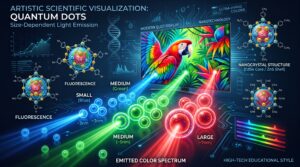
Quantum dots are nanocrystals typically measuring just a few nanometers across. At that scale, electrons become confined, and the particle’s energy levels shift according to its exact size. Smaller dots tend to emit higher-energy (bluer) light; larger ones emit lower-energy (redder) light.
This size-tunable emission is the core property that makes quantum dots useful. Unlike bulk materials or traditional dyes, a single chemical composition can produce a wide range of colors simply by changing particle diameter. The emission peaks are also relatively narrow, which yields pure, saturated colors.
Manufacturers grow these crystals with tight size control so that entire batches emit nearly the same wavelength. That consistency is what allows quantum-dot technology to deliver reliable performance in commercial devices.
Quantum Dots in Display Technology
The most visible application sits inside modern televisions and monitors. Quantum-dot enhancement films or layers convert light from a blue LED backlight into highly pure red and green. The result is a wider color gamut and better brightness efficiency than many older LCD designs.
You will often see marketing labels such as QLED. In most current consumer sets, quantum dots serve as a color-conversion layer rather than the primary light source. True electroluminescent quantum-dot displays, where the dots themselves emit light when electrically excited, remain closer to the research and early-commercial stage.
The practical benefit for viewers is more vivid color with less energy wasted on filtering. When you compare a good quantum-dot LCD next to a conventional one, the difference in red and green saturation is usually obvious.
Emerging and Specialized Uses Beyond Screens
Quantum dots also appear in medical imaging and biological research. Certain formulations can be attached to molecules of interest and will fluoresce strongly under the right illumination, letting researchers track processes inside cells with high precision. Their brightness and resistance to fading give them advantages over some traditional fluorescent dyes.
Solar energy researchers continue testing quantum-dot layers that capture wavelengths conventional silicon cells miss. Progress has been steady, though widespread commercial solar panels based on the technology are still limited. Other exploratory areas include quantum-dot lasers, security inks, and specialized sensors.
Each new application demands careful attention to stability, toxicity, and manufacturing cost. Cadmium-based dots offer excellent optical performance but face regulatory and environmental constraints, so indium-based and other cadmium-free alternatives have gained ground.
Practical Considerations and Limitations
Quantum dots are not magic. In displays they improve color, yet overall picture quality still depends on panel type, local dimming, processing, and other factors. A quantum-dot layer cannot turn a mediocre screen into a reference monitor by itself.
Longevity and heat resistance matter for real products. Early generations faced challenges with degradation under prolonged high brightness; materials and encapsulation methods have improved substantially. For medical or environmental uses, biocompatibility and clearance from the body remain active research topics.
When you evaluate a product that advertises quantum dots, look past the label. Ask how the dots are used, whether the implementation is photoluminescent or electroluminescent, and what independent measurements say about color volume and efficiency.
FAQ
Are quantum dots only used in TVs?
No. While displays are the most common consumer application, they also appear in biomedical imaging, research tools, and emerging energy technologies.
Do quantum-dot TVs use real quantum dots?
Yes. Most current QLED-style sets use quantum-dot films or layers to convert light and improve color performance.
Are quantum dots toxic?
Some of the highest-performing formulations contain cadmium and require careful handling and encapsulation. Cadmium-free alternatives are increasingly common in commercial products.
How small are quantum dots?
They typically range from roughly 2 to 10 nanometers in diameter—small enough for quantum confinement effects to dominate.
Will quantum dots replace OLEDs?
They currently complement LCD technology more than they replace OLED. Electroluminescent quantum-dot displays could eventually compete more directly, but that transition is still underway.
See the Technology for What It Actually Delivers
Quantum dots are nanoscale semiconductor crystals whose size determines the color of light they emit or convert. That precise control has already improved the color performance of many televisions and monitors and continues to open doors in medicine, sensing, and energy research.
Next time you encounter the term on a product sheet or in a news story, you will know the core mechanism and the most established uses. Keep an eye on materials advances and real performance data rather than marketing claims alone. The technology is both more practical and more limited than the hype sometimes suggests—understanding the difference lets you judge its value clearly.