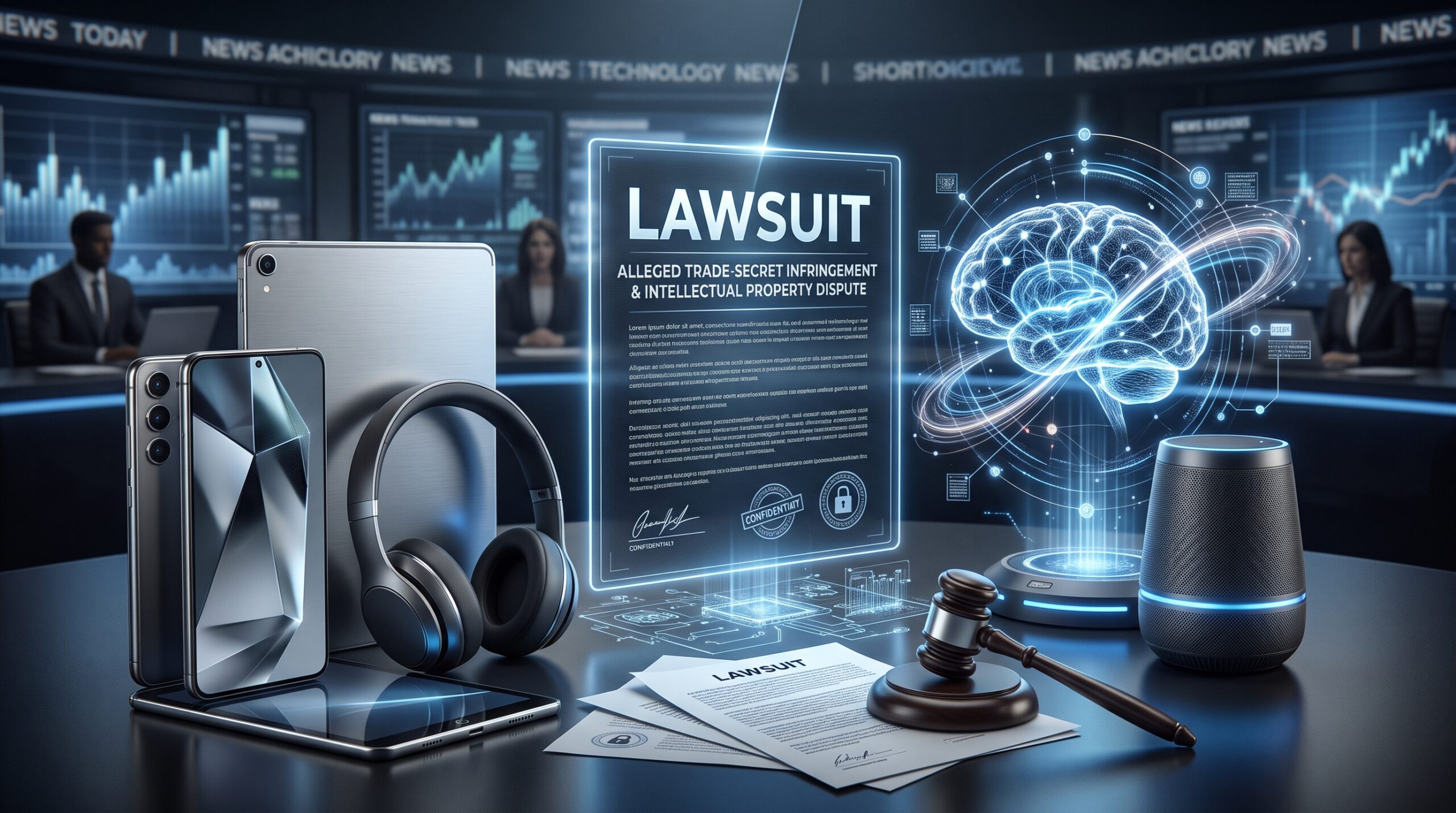
Apple and OpenAI are no longer simply partners in the artificial intelligence race. They are now facing each other in a high-stakes legal battle over allegations involving trade secrets, former employees and OpenAI’s emerging hardware ambitions.
Apple filed a lawsuit in July accusing OpenAI, its hardware business io Products and former Apple employees of misappropriating confidential information. OpenAI has strongly rejected the accusations, saying it has no interest in Apple’s trade secrets and that the complaint lacks merit.
The dispute has become even more significant because OpenAI is reportedly working toward a new generation of consumer hardware. That makes the lawsuit about more than confidential files or employee conduct. It could influence how OpenAI builds products that may eventually compete for the same consumer attention Apple has dominated for years.
Now OpenAI is pushing back more aggressively.
Why Apple Sued OpenAI
Apple’s lawsuit centers on claims that former employees who moved from Apple to OpenAI improperly accessed or shared confidential information. The complaint names OpenAI, io Products, OpenAI hardware chief Tang Tan and former Apple engineer Chang Liu. Apple alleges that confidential information concerning unreleased products, hardware components, suppliers and manufacturing processes was improperly obtained.
The allegations are particularly sensitive because of the backgrounds of the people involved. Tan spent roughly 24 years at Apple and held senior product-design responsibilities, while Liu previously worked as a senior systems electrical engineer at the company. Apple argues that their knowledge and access could have provided OpenAI with valuable insight as it develops consumer hardware.
Apple’s complaint also alleges that OpenAI’s recruiting process encouraged candidates to disclose confidential information or bring Apple hardware components into interviews. Those are allegations made by Apple, not established findings by a court, and OpenAI disputes the broader characterization of its conduct.
That distinction matters.
Trade-secret litigation is not simply about whether an employee previously worked for a competitor. Engineers and designers routinely move between technology companies, and their general knowledge and professional experience normally follow them. The legal question is whether protected confidential information was actually acquired, used or disclosed improperly.
For technology companies, that line can be incredibly valuable. A former employee’s experience is one thing; a confidential product specification or supplier strategy is another.
OpenAI Fires Back At Apple
OpenAI initially responded to Apple’s lawsuit by saying it was not aware of evidence supporting Apple’s allegations and emphasizing its belief in fair competition and employees’ freedom to choose where they work.
The response has since become more forceful.
OpenAI has challenged Apple’s version of events and publicly argued that Apple is getting the case wrong. The company has also pointed to communications involving former Apple employee Chang Liu as part of its effort to dispute Apple’s narrative. Recent reporting says OpenAI published messages and additional context intended to challenge aspects of Apple’s allegations.
Then came the legal escalation.
Reuters reported on August 6 that OpenAI filed a motion asking a federal judge to dismiss Apple’s trade-secret lawsuit. OpenAI argues that Apple has not adequately identified the alleged trade secrets or plausibly shown that OpenAI misappropriated them. OpenAI also maintains that it is developing new technology rather than relying on Apple’s confidential information.
That is a critical moment in the case.
A dismissal motion does not mean OpenAI has won. It is essentially an argument that Apple’s lawsuit, as currently presented, does not meet the legal requirements needed to proceed on some or all of its claims.
The judge will ultimately determine how much of the case moves forward.
The Bigger Battle May Be AI Hardware
Behind the legal arguments sits a much larger technology story: OpenAI wants to become more than a software company.
OpenAI’s acquisition of io Products, a hardware company co-founded by former Apple design chief Jony Ive, has intensified speculation about the company’s consumer-device ambitions. Reports have described possible OpenAI hardware designed around an AI-first experience rather than the traditional smartphone interface.
That context explains why Apple’s allegations have attracted so much attention.
If OpenAI were simply developing another chatbot, Apple’s lawsuit might have remained a narrower intellectual-property dispute. But hardware changes the competitive equation. Product design, manufacturing relationships, component sourcing, industrial design and user-interface decisions can become strategic advantages worth billions of dollars.
For Apple, protecting confidential information is therefore about more than defending old projects. It is about preventing sensitive knowledge from becoming an advantage for a potential future competitor.
For OpenAI, the stakes are equally high.
The company needs experienced hardware engineers and designers to build consumer devices. Many of the world’s most accomplished hardware professionals have experience at companies such as Apple. If hiring former Apple employees creates significant legal exposure, OpenAI could face additional restrictions and scrutiny as it expands its hardware organization.
That could make talent acquisition more complicated.
And in the technology industry, speed matters.
What The Lawsuit Could Mean For OpenAI’s Hardware Plans
The immediate question is whether Apple’s lawsuit can slow OpenAI’s hardware ambitions.
Apple has sought court intervention in the dispute, including measures aimed at preventing alleged confidential information from being used or disclosed. Recent reporting also indicates that Apple is pursuing expedited discovery and seeking a preliminary injunction.
If the court allows Apple’s claims to proceed, OpenAI could face extensive discovery. That could mean reviewing employee communications, access records, recruiting activity, technical documents and other evidence related to the allegations.
For a company developing unreleased consumer hardware, that creates an obvious business problem.
Confidentiality is everything during product development.
A legal investigation can potentially force companies to demonstrate that their designs were created independently and that employees did not improperly transfer protected information from previous employers. Even if OpenAI ultimately defeats Apple’s claims, defending the lawsuit can consume time, money and executive attention.
There is another issue that consumers should watch closely: product delays.
If OpenAI’s hardware program requires changes to its development processes, additional legal reviews or restrictions on particular personnel, the company’s path toward launching a device could become slower.
However, it would be premature to assume that Apple’s lawsuit will stop OpenAI from releasing hardware.
There is currently no final court ruling establishing that OpenAI stole Apple’s trade secrets. OpenAI strongly denies Apple’s allegations, and the company’s motion to dismiss shows that it intends to challenge the case rather than simply settle the dispute quietly.
Why This Matters To The AI Industry
The Apple versus OpenAI lawsuit could become an important test for the rapidly evolving AI hardware industry.
Generative AI companies are increasingly moving beyond websites and smartphone applications. They want their technology to become part of everyday physical products, from computers and wearable devices to home assistants and potentially entirely new categories of hardware.
That creates a difficult intellectual-property problem.
AI companies need talent. Established hardware companies have enormous pools of talented engineers and designers. When those employees move between companies, they naturally bring experience with them. But companies must ensure that legitimate professional knowledge does not become mixed with confidential corporate information.
The Apple-OpenAI case could therefore become a warning for the entire technology sector.
Companies hiring competitors’ employees may need stronger onboarding procedures, stricter document-access controls and clearer instructions about what new employees can and cannot bring from previous jobs.
Employees also have responsibilities.
A designer can use skills learned during years of professional experience. That does not automatically give the person permission to copy confidential documents, unreleased specifications, proprietary source material or protected business information from a former employer.
For startups, the lesson is especially valuable.
Fast-moving companies often prioritize innovation and speed. But when employees arrive from major competitors, basic information-security procedures can become just as important as engineering talent.
A single access-control mistake can create years of legal headaches.
What Happens Next In The Apple vs. OpenAI Case?
The next major stage will be legal rather than technological.
OpenAI’s motion to dismiss gives the company an opportunity to argue that Apple’s complaint does not sufficiently establish the necessary elements of its claims. Apple, meanwhile, will have an opportunity to defend its allegations and continue seeking evidence.
The court’s decisions on discovery and any request for preliminary relief could shape the pace of the dispute.
There is also a fascinating business complication: Apple and OpenAI have worked together.
Apple integrated ChatGPT into its broader Apple Intelligence ecosystem, making the companies partners in the consumer AI market even as they compete in other areas. That relationship makes the lawsuit unusually complicated.
Two companies can cooperate in one area and compete aggressively in another.
That is becoming increasingly normal in technology.
Microsoft and OpenAI provide another example of how partnerships can exist alongside competition. Cloud providers can work with AI companies while simultaneously developing their own products. Hardware companies can integrate third-party AI services while building proprietary AI capabilities.
The Apple-OpenAI dispute demonstrates how quickly those relationships can become complicated when the companies begin competing for the same future markets.
For consumers, the most interesting question may not be who wins the lawsuit.
It may be what OpenAI eventually builds.
If OpenAI succeeds in creating a compelling AI-native device, the company could challenge the traditional smartphone-centered model of consumer technology. If Apple successfully establishes that confidential information was improperly used, however, the case could force OpenAI and other AI companies to rethink how they recruit hardware talent and protect intellectual property.
Either way, the outcome could influence the next generation of consumer electronics.
Final Takeaway
OpenAI’s response to Apple’s trade-secret lawsuit marks a significant escalation between two companies that have recently been partners as well as competitors.
Apple alleges that confidential information was improperly obtained through former employees and used in connection with OpenAI’s hardware ambitions. OpenAI rejects those accusations and has moved to challenge the case, arguing that Apple has not demonstrated a sufficient basis for its claims.
The court has not made a final determination that OpenAI stole Apple’s trade secrets.
That is the key point readers should keep in mind.
The case is still developing, and the legal arguments could change as evidence emerges. But regardless of the final outcome, the dispute highlights a much bigger trend: AI companies are moving into hardware, and the competition for engineering talent, proprietary technology and consumer attention is becoming more intense.
For technology watchers, this is a case worth following closely.
The next major development could tell us not only how the legal dispute progresses, but also how aggressively OpenAI intends to challenge Apple’s position in consumer hardware.
FAQ
What is the Apple vs. OpenAI lawsuit about?
Apple has accused OpenAI, io Products and former Apple employees of misappropriating confidential information and trade secrets. OpenAI disputes the allegations and says Apple’s complaint lacks merit.
Did OpenAI admit to stealing Apple’s trade secrets?
No. OpenAI has denied Apple’s allegations and has said it has no interest in other companies’ trade secrets. The company is actively challenging Apple’s claims.
Why is Apple concerned about OpenAI hardware?
OpenAI is expanding into consumer hardware, including through its relationship with io Products and former Apple design executive Jony Ive. Apple’s lawsuit alleges that confidential Apple information could benefit those hardware efforts.
Has the court ruled that OpenAI stole Apple’s secrets?
No. As of August 9, 2026, the allegations remain disputed. OpenAI has filed a motion seeking dismissal of Apple’s lawsuit, and the case remains ongoing.
Could the lawsuit delay OpenAI’s hardware products?
Potentially, but there is no confirmed evidence that Apple’s lawsuit will delay a specific OpenAI product. Discovery, court orders or other legal requirements could increase costs and complexity, but the ultimate impact remains uncertain.
Why is this case important for the technology industry?
The dispute highlights the growing competition between AI companies and established hardware companies. It also shows why intellectual-property protection, employee offboarding and responsible hiring practices are becoming increasingly important as AI companies enter the hardware market.